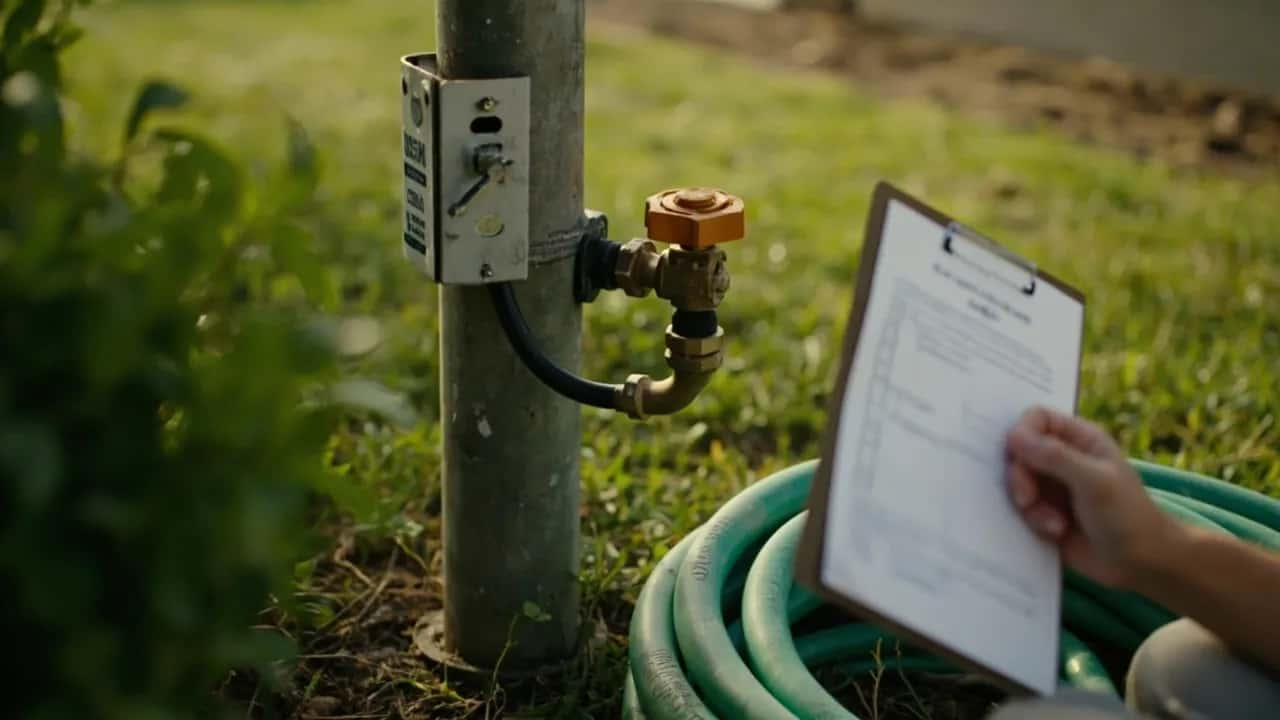
How Often Is Backflow Testing Required for a Home Irrigation System?
How Often Is Backflow Testing Required for a Home Irrigation System?
Backflow testing is commonly annual for home irrigation systems, yet the requirement comes from your local water provider and state rules.
This guide explains how to read the notice, book a certified tester, and keep the report moving.
The short answer to the question of how often backflow testing is required for a home irrigation system is once each year in many U.S.
cities, although the exact rule comes from your local water provider and state code.
[1] The common mistake is assuming that a new installation only needs one test; many utilities require annual testing and a certified tester’s report on file.

The short answer to the question of how often backflow testing is required for a home irrigation system is once each year in many U.S.
cities, although the exact rule comes from your local water provider and state code.[1] The common mistake is assuming that a new installation only needs one test; many utilities require annual testing and a certified tester’s report on file.[1][3]
The ValveDue product page presents a planned iPhone tool for keeping dates that come from water-utility notices,
with the idea that a logged test pushes the next due date forward by a year;
it is not yet on the App Store,
and its features and data handling are unconfirmed.[4] Local rules and the utility’s current notice remain authoritative.
Annual testing is the baseline in many U.S. cities, but it is not a single national interval.
The Portland Water Bureau says state law and City Code require backflow prevention assemblies at properties with certain water uses to be tested at least once each year by a state-certified tester.[1] Seattle Public Utilities likewise says annual testing by a certified Backflow Assembly Tester is the only way to ensure proper function,
and it cites Washington State law.[3]
Texas shows why a homeowner should not rely on a single national rule.
The TCEQ cross-connection guidance says a licensed backflow prevention assembly tester must check the assembly when it is installed on an irrigation system,
and it warns that your water provider may have adopted additional codes requiring an annual test.[2] That makes the local notice the controlling document:
it can be stricter than the state minimum.
| Situation | What to check | Your next step |
|---|---|---|
| You just had an irrigation system installed | TCEQ-style rules may require a licensed tester to check the assembly at installation, and the water provider may add an annual test.[2] | Ask the installer for the assembly ID, test ports, and the report or permit details. |
| You received an annual reminder letter | Portland Water Bureau tells residential customers to test each spring when the reminder arrives.[1] | Book the test before the due date printed on the notice, not after it. |
| You have no reminder but own an irrigation system | Seattle Public Utilities treats annual testing as the way to confirm function and cites state law.[3] | Check the utility’s backflow page and the last report before assuming you are current. |
| You are buying or selling the home | The report trail matters more than a verbal assurance. | Ask for the latest test report and the utility’s current notice. |
Key Takeaways
- Annual backflow testing is common for home irrigation assemblies, but the water provider’s current notice and local code control the actual due date.[1][2][3]
- A certified or licensed tester performs the test; a sprinkler blowout or spring startup is not a substitute for a backflow test.[1][2]
- The tester usually files the report with the water system, and Portland’s page states a 10-business-day filing window for its process.[1][2][3]
- Keep the notice, the test report, and the next due date together so the annual cycle does not depend on memory.
- If an assembly is new or newly listed by the utility, ask the provider whether an installation test is required.[2]
What the Annual Rule Means in Practice
A backflow assembly keeps water from flowing backward into the drinking-water supply; Seattle describes the purpose as protecting drinking water from potential contamination sources.[3] For a home irrigation system, the assembly is the testable device between the irrigation piping and the public water supply.
The annual rule has three moving parts: the due date on the utility notice, the certified tester who performs the test, and the report that reaches the water provider.[1][3]
Portland’s process is a useful model.
The Water Bureau sends property owners a reminder letter about testing requirements each year, and it tells residential customers to test each spring when the letter arrives.[1] After the test, the tester submits a backflow test report to the Water Bureau within 10 business days.[1] Seattle’s instructions are similar in shape: the tester submits the report directly to Seattle Public Utilities after testing.[3] TCEQ also notes that backflow forms must be submitted to the responsible water system for recordkeeping.[2]
The practical due date is not always the date you remember.
It is the date the utility has on file or the due date printed on the current notice.[1][3] If your utility uses a reminder letter, treat the letter as a scheduling trigger, not as the legal source of the obligation.[1] If the letter never arrives, the assembly can still be past due.
How to Read Your Utility Notice and Test Report
Read the notice for four fields before you call anyone: the utility name, the assembly ID or service address, the test due date, and the report submission instructions.[1][3] The report should show the tester’s credential, the assembly details, the test result, and the date of service.
A report that only says it passed without identifying the assembly is hard for a utility to match to your account.[1][3]
Do it now:
- Find the most recent notice or report and write down the utility, assembly ID, due date, and tester name.
- Check the tester’s credential with the state or utility list before booking; Portland and Seattle both require certified testers for their programs.[1][3]
- Ask the tester who submits the report and on what timeline; Portland’s stated window is 10 business days.[1]
- Save the confirmation and set a reminder for the next annual cycle; the next due date usually follows the same annual rhythm unless the utility says otherwise.[1][3]
- If you move or sell the home, leave the latest report with the property records and tell the buyer or agent where the utility notice is kept.
Fill-in line for your calendar: Utility: ____; Assembly ID: ____; Due date: ____; Tester: ____; Report sent on: ____
Three Mistakes That Cause Failed or Missing Tests
Treating the installation test as a lifetime pass is the first common mistake.
TCEQ requires a licensed tester to check an irrigation assembly when it is installed, but the same page warns that the water provider may require an annual test as well.[2] A passing installation report answers a different question from a current annual report.
Hiring a tester who is not credentialed for the utility’s program creates the second common problem.
Portland requires a state-certified backflow assembly tester, and Seattle requires a Washington-certified tester.[1][3] TCEQ frames the requirement as a licensed backflow prevention assembly tester.[2] A convenient visit is not useful if the report cannot be accepted.
A sprinkler blowout is not a backflow test, and treating them as one creates the third common problem.
A blowout clears water from irrigation lines before freezing; a backflow test measures whether the assembly protects the drinking-water supply.[1][3] They may happen in the same season, but they produce different records.
Seattle notes that if testing is not completed, the utility may assess non-compliance charges and possibly terminate water service.[3]
When Annual Testing Is Not Enough
Annual testing is a floor, not a promise that nothing else applies.
TCEQ’s page shows that installation checks and provider-specific rules can add requirements beyond the state baseline.[2] Portland’s annual requirement applies to assemblies at properties with certain water uses, so the first question is whether your property is in the program at all.[1] A utility notice or the backflow program staff should settle that question.
The advice stops being reliable when the local notice names a different interval, a different assembly type, or a specific filing portal.
At that point, the notice and the utility’s written instructions outrank any general guide.[1][2][3] A licensed tester can tell you what test was performed; the water provider decides what it accepts.
If you cannot find the current notice, call the utility’s backflow program and ask for the account’s status rather than guessing from an old letter.[1][3]
Frequently Asked Questions
Does a home sprinkler system need backflow testing every year?
Many water utilities require annual backflow testing for a home irrigation system, but the rule is local rather than a single national standard.[1][3] Check the current notice from your water provider, confirm the assembly is listed, and use a certified or licensed tester.
If the notice gives a different interval, follow the notice.[1][2]
Who is allowed to test a backflow assembly?
A state-certified or licensed backflow assembly tester must perform the test; a landscaper or sprinkler technician is not automatically qualified.[1][2] Portland requires a state-certified tester, Seattle requires a Washington-certified tester, and TCEQ requires a licensed tester for irrigation assemblies.[1][2][3] Ask the tester who submits the report to the utility.[1][3]
What happens if I miss the annual backflow test?
Missing the test can lead to non-compliance charges or even loss of water service in some cities.[3] The safer next step is to book a certified tester promptly, tell the utility what happened, and keep the test report confirmation.[1][3] Local rules control the consequences, so read the notice rather than guessing.[1]
Can ValveDue file my backflow test report?
No.
ValveDue is a planned organizer for water-utility dates and home-maintenance reminders, and it is not a water utility, tester, or filing service; it cannot guarantee compliance or prevent fines.[4] Use the utility’s current notice and a certified tester for the official record.[4]
References
[1] Portland Water Bureau Backflow Testing Requirements and Reports https://www.portland.gov/water/backflow-prevention/testing-requirements-and-reports
[2] TCEQ Cross-Connection Control and Backflow Prevention https://www.tceq.texas.gov/drinkingwater/cross-connection
[3] Seattle Public Utilities Backflow Assembly Testing https://www.seattle.gov/utilities/your-services/water/water-quality/backflow-prevention/backflow-testing
[4] ValveDue product page https://taoapex.com/en/products/valvedue/