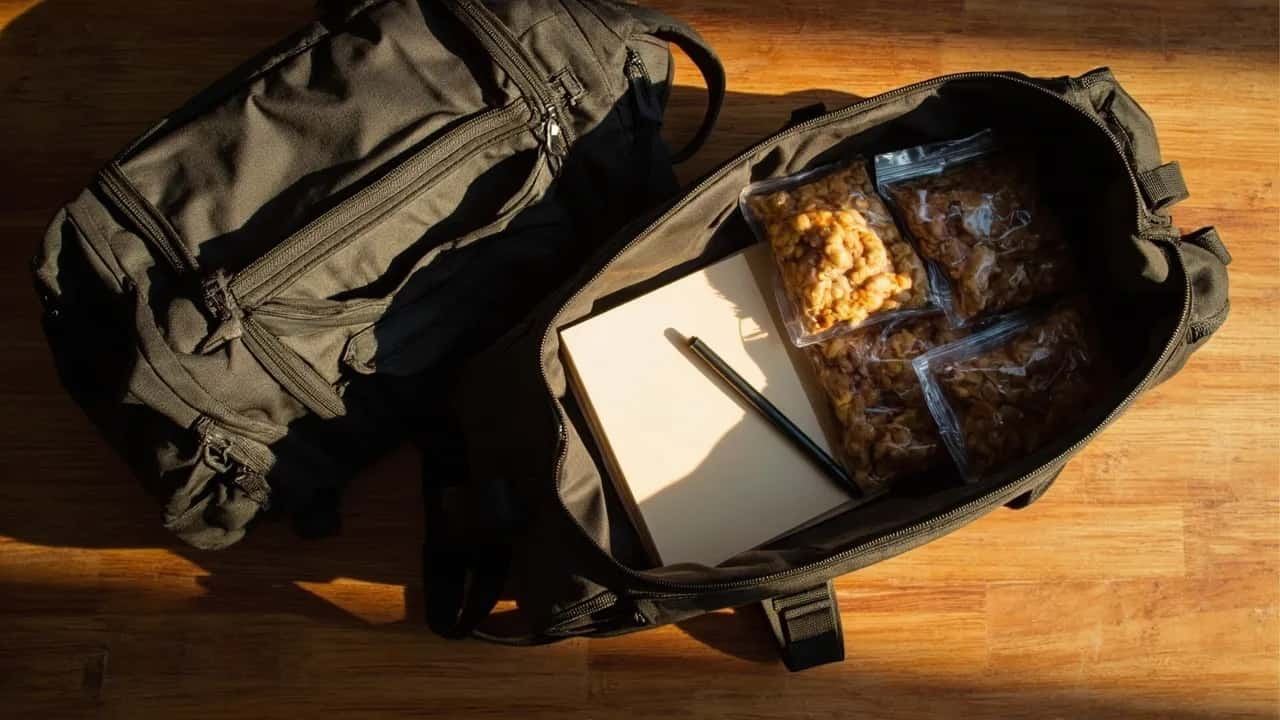
Low FODMAP Travel: How to Plan Meals and Keep a Record Away From Home
Low FODMAP Travel: How to Plan Meals and Keep a Record Away From Home
Plan low FODMAP meals around airport security and restaurant uncertainty, and keep a fast food-and-symptom log without spending your trip typing.
Labels list grams and percent Daily Value (%DV) based on a 50-gram daily value for a 2,000-calorie diet, where 5% DV or less is a low source and 20% DV or more is a high source [5].
Pair that with two-tap symptom check-ins when reminders fire, and 14 days of consistent logging (30 meals and 20 symptoms) can surface your personal Trigger Report once you return [2].

FODMAPs are fermentable short-chain carbohydrates—sugars, starches, and fiber—that absorb poorly in the small intestine and ferment in the colon [1].
Successful low FODMAP travel relies on packing safe solid snacks for transit, avoiding unlabeled foods where ingredients cannot be verified, and keeping a brief meal-and-symptom record across the trip.
Away from your home kitchen, relying on memory rarely works because flights, schedule shifts, and restaurant sauces blur together.
Using a dedicated mobile tracker such as TriggerMap lets you search 1,300+ FODMAP-rated foods, snap a meal or label photo,
and record symptoms in two taps while keeping your diary on your device [2].
Which Travel Tracking Method Fits Your Trip?
Choosing the right tracking method before departure keeps your food log realistic when transit delays or long days cut into your time.
| Tracking Method | Best For | Setup Effort | Where It Breaks Down |
|---|---|---|---|
| Pocket notebook or phone notes | Short trips with familiar packed staples | Zero setup | Difficult to spot overlapping moderate ingredients across days |
| Custom spreadsheet | Detailed home-style logs with Wi-Fi | High initial setup | Slow to enter meals one-handed at gates or restaurants |
| Dedicated FODMAP tracker | Multi-day trips with dining out and snacks | Minimal setup | Needs an iPhone (iOS 17+) and steady check-ins [2] |
Simple paper or phone notes beat an app when you eat mostly packed snacks you already know you tolerate, because jotting down two familiar items takes seconds.
Structured digital logging pulls ahead once you eat unfamiliar restaurant meals, track symptom timing after delays, or want to catch ingredient overlaps without reviewing pages of notes.
1. Pack Transit-Safe Foods Around Security Rules
Packing tolerated snacks and extra medication before leaving home prevents hunger from forcing risky choices at airport terminals or roadside stops.
Pack safe snacks or meals for flights and airports, and bring enough prescription and over-the-counter medicines for the entire trip plus extra in case of delays [3].
At U.S.
airport checkpoints, TSA food screening rules allow solid food items in both carry-on and checked bags,
whereas bottled water and liquid or gel foods must be 3.4 ounces (100 milliliters) or less in a carry-on [4].
Put snacks in an easy-to-reach pouch because officers may ask travelers to separate foods, powders, or cluttering items for X-ray screening, though the X-ray machine does not adversely affect food or medicines [4].
- Pack dry, single-serving snacks in your carry-on for boarding and unexpected layovers [3].
- Place liquid or gel foods larger than 3.4 oz (100 ml), such as sauces or dips, in checked luggage [4].
- Keep prescription and over-the-counter gut medicines in your carry-on with extra doses for delays [3].
- Contact TSA Cares before U.S. flights if you need special screening accommodations for medical or dietary supplies [4].
2. Screen Restaurant Menus and Package Labels Fast
Reading ingredient lists carefully and asking direct questions before ordering reduces guesswork when unfamiliar menus replace home cooking.
CDC travelers' allergy guidance notes that hot-served, dry, and packaged foods are usually safe for avoiding allergens,
though that guidance does not establish low-FODMAP safety,
and unlabeled dishes or street food should be avoided when there is no reliable way to check ingredients [3].
Ask airport and destination restaurants about sauces, marinades, and seasonings before you order, and carry translated restriction cards if you also manage food allergies [3].
You can pair those questions with a quick low FODMAP eating-out log so servers and kitchen staff only have to confirm a few hidden ingredients.
When grabbing packaged snacks in the United States, scan both the ingredient list and the Nutrition Facts panel for added sugars, which include syrups, honey, and concentrated fruit or vegetable juices [5].
Labels list grams and percent Daily Value (%DV) based on a 50-gram daily value for a 2,000-calorie diet, where 5% DV or less is a low source and 20% DV or more is a high source [5].
3. Keep a Quick Away-From-Home Record
Capturing what you ate, when you ate it, and how your gut felt within a few hours turns a messy trip into usable data.
Waiting until bedtime to recall three meals and two snacks erases portion details and symptom timing,
whereas logging right at the table takes seconds (see our guide on how to keep an IBS food diary for baseline setup).
Copy this compact five-line entry format into your phone notes if you prefer manual tracking on the road:
Time & Place: [e.g., 12:30 PM, Gate B4 / Local Cafe]
Meal or Item: [Main food + sauce, sweetener, or drink]
Portion & Overlap: [Small / standard; 1 or 2+ moderate foods?]
Symptoms (2–4 hrs later): [None / mild / moderate / severe + type]
Trip Context: [Flight day, short sleep, missed meal, long walk]
If typing notes mid-transit feels tedious, TriggerMap on the App Store lets you pick favorites, search 1,300+ traffic-light-rated foods,
or snap a meal or label photo on iOS 26 without uploading the image,
while warning you if one meal stacks two or more moderate-FODMAP foods [2][7].
Pair that with two-tap symptom check-ins when reminders fire, and 14 days of consistent logging (30 meals and 20 symptoms) can surface your personal Trigger Report once you return [2].
In an illustrative travel-day scenario, a traveler logs a rushed airport breakfast containing two moderate-FODMAP items and records level 3 bloating two hours later.
Seeing that overlap in their log, they switch to simple packed staples for lunch and note level 1 discomfort by evening, deciding to keep moderate foods separated for the rest of the trip.
4. Know When Travel Records Hit Their Limits
A travel food log shows correlations during your trip, not a medical diagnosis, because jet lag, altered meal timing, and hydration changes can mimic food reactions.
The low FODMAP diet is a short-term elimination approach where a provider typically has you add foods back one at a time after about 6 weeks to identify which foods trigger IBS symptoms [1].
Because the diet is restrictive, check with a healthcare provider so you continue getting proper nutrients rather than keeping your diet overly narrow after a rough trip [1].
Sudden fiber swings on vacation also matter: the Dietary Guidelines for Americans (2020–2025) recommend 22 to 34 grams of fiber per day for adults, and NIDDK notes that adding fiber slowly by 2 to 3 grams a day may help prevent gas and bloating [6].
Pause formal trigger challenges until your schedule settles at home, and speak with a doctor or dietitian if symptoms persist or worsen.
Key Takeaways
- Pack solid snacks first: Solid foods pass U.S.
- TSA checkpoints in carry-on or checked bags, while liquids and gels over 3.4 oz (100 ml) belong in checked luggage [4].
- Choose verifiable meals: CDC allergy guidance notes hot-served, dry, and packaged foods are usually safe for avoiding allergens, though that does not establish low-FODMAP safety—confirm ingredients, skip unlabeled dishes, and check U.S.
- labels for added honey, syrups, or fruit juice concentrates [3][5].
- Log context with food: Record meal timing, possible FODMAP overlaps, symptoms, and trip stressors immediately rather than reconstructing the day at night.
- Save food testing for home: Follow structured elimination and one-by-one reintroduction timelines—typically around 6 weeks—with guidance from a qualified healthcare provider [1].
Frequently Asked Questions
Can I bring low FODMAP snacks through airport security?
Yes, solid snacks such as crackers, nuts, or dry bars can travel in either carry-on or checked bags at U.S.
TSA checkpoints [4].
Liquid or gel items like yogurt, dips, or bottled water over 3.4 ounces (100 milliliters) are not allowed in carry-on; check them if possible or leave them behind, and officers may ask you to separate foods for X-ray screening [4].
Should I start FODMAP reintroduction while traveling?
No, it is better to wait until you return to a predictable routine before testing trigger foods one at a time.
MedlinePlus notes that providers typically guide you to add foods back individually after about 6 weeks of elimination [1], whereas travel delays and restaurant unknowns make symptom patterns harder to read.
What should I record in a travel food diary besides what I ate?
Record the meal time, sauces or sweeteners, whether two moderate-FODMAP foods appeared together, symptom severity, and non-food factors like flight delays or short sleep.
Sudden shifts in fiber can also upset digestion, so adding fiber slowly by 2 to 3 grams a day may help prevent gas and bloating [6].
Can I use TriggerMap to log meals away from home without a subscription?
Yes, TriggerMap is a free download for iPhones running iOS 17 or later and includes meal and symptom logging, the 1,300+ FODMAP food library, and stacking detection without a subscription [2].
A Pro subscription adds weekly reports, unlimited AI meal scanning, HealthKit insights, PDF export, and the full Trigger Report after 14 days [2].
References
[1] MedlinePlus Low FODMAP Diet https://medlineplus.gov/ency/patientinstructions/000984.htm
[2] TriggerMap product page https://taoapex.com/en/products/triggermap/
[3] CDC Travelers Health Allergies https://wwwnc.cdc.gov/travel/page/allergies/
[4] TSA What Can I Bring Food https://www.tsa.gov/travel/security-screening/whatcanibring/food
[5] FDA Added Sugars Nutrition Label https://www.fda.gov/food/nutrition-facts-label/added-sugars-nutrition-facts-label
[6] NIH NIDDK IBS Diet Guide https://www.niddk.nih.gov/health-information/digestive-diseases/irritable-bowel-syndrome/eating-diet-nutrition
[7] App Store listing https://apps.apple.com/app/id6814403702