How Accurate Are Photo Calorie Counters? What AI Estimates Can and Cannot Do
Understand calorie and macro estimates, review food portions and build an editable meal log with CalShutter.
No universal diet target or accuracy guarantee.
What does "How Accurate Are Photo Calorie Counters? What AI Estimates Can and Cannot Do" cover?
Understand calorie and macro estimates, review food portions and build an editable meal log with CalShutter.
No universal diet target or accuracy guarantee. There is no verified universal error percentage for photo calorie counters.
TaoApex has not published a controlled accuracy benchmark for CalShutter.
Treat the result as an editable estimate, not a guaranteed tolerance or a safe medical calculation.
The model looks at the photo, identifies the foods, estimates portion size from visual references (plate size, utensils, hand cues), and sums published nutrition data per ingredient.

Key Takeaways
- 1There is no verified universal error percentage for photo calorie counters.
- 2The model looks at the photo, identifies the foods, estimates portion size from visual references (plate size, utensils, hand cues), and sums published nutrition data per ingredient.
- 3A photo may not show oil, sauce or the ingredients inside a mixed dish.
There is no verified universal error percentage for photo calorie counters.
TaoApex has not published a controlled accuracy benchmark for CalShutter.
Treat the result as an editable estimate, not a guaranteed tolerance or a safe medical calculation.
Where the estimate comes from
The model looks at the photo, identifies the foods, estimates portion size from visual references (plate size, utensils, hand cues), and sums published nutrition data per ingredient.
It is an estimate pipeline, not a measurement —
no camera can see oil absorbed during cooking or sugar dissolved into a sauce.
What drives the error
- A photo may not show oil, sauce or the ingredients inside a mixed dish.
- Bowl depth and camera angle can make portion sizes ambiguous.
- Similar-looking foods can have different ingredients.
Check the recipe or label when available; do not assume that every omission can be corrected from the image alone.
Why consistent logging can still contain error
A consistent log can still contain a consistent bias. Review portions and ingredients rather than assuming that repetition cancels error.
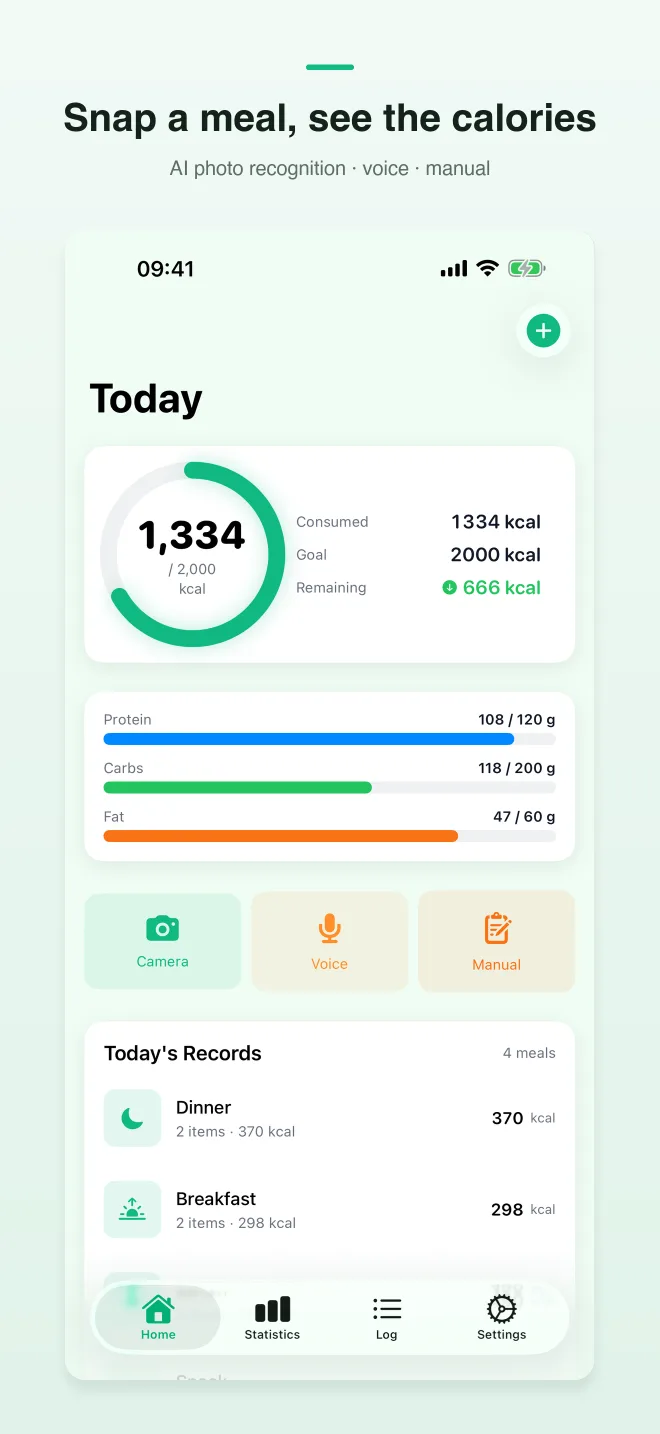
CalShutter offers photo, voice and manual input; choose the input that best describes the meal and review it before saving.
How to tighten your estimates
- Identify the proposed foods and check for missing items.
- Add known oils, dressings or preparation details.
- Compare the portion with a label, recipe or weighed ingredient when you need more detail.
- Edit the entry before saving.
These are review steps, not a validated accuracy-improvement percentage.
When photo estimates are not enough
For medical diets or medication decisions, a consumer photo estimate is not a substitute for the recording method recommended by a qualified clinician.
Do not use estimated calories or carbohydrate amounts to calculate medication doses.
The takeaway
Use photo recognition as a draft.
For a diet requiring precise measurements, ask your clinician or registered dietitian about an appropriate recording method.
A photo log must not be used for medication dosing.
Actual app screens: review before saving
References
[1] https://www.niddk.nih.gov/health-information/weight-management/body-weight-planner
[2] https://www.niddk.nih.gov/health-information/weight-management/just-enough-food-portions

Related Reading
Frequently Asked Questions
1How accurate is a photo estimate?
TaoApex has not published a controlled CalShutter accuracy benchmark.
Review foods and portions before saving; no universal error percentage is guaranteed.
2Should I copy a calorie or macro target from this guide?
No. Individual targets depend on health and circumstances. Seek qualified guidance if you need a weight-management or therapeutic diet plan.
3What can CalShutter do?
On iPhone, CalShutter creates editable nutrition estimates from food photos or voice input and also supports manual logging.
It is not a medical device.